+86-18815018869
  josie@one-paper.com
+86-18815018869
josie@one-paper.com
josie@one-paper.com
+86-18815018869
josie@one-paper.com

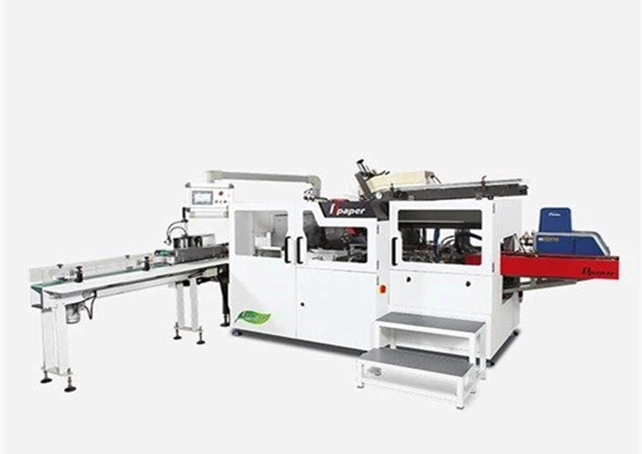
The tissue folding machine revolutionizes tissue production by automating the intricate process of folding tissues into specific configurations. This innovation not only boosts production efficiency and uniformity but also minimizes manual intervention, allowing manufacturers to meet high market demands with products of consistent quality and presentation.
Tissue paper folding machines play a pivotal role in streamlining production processes within the paper industry. These machines automate the folding of tissue paper into various configurations, significantly increasing production speed and efficiency. By replacing manual folding, they not only accelerate production rates but also ensure uniformity and precision across products, enhancing overall quality. Furthermore, the integration of these machines reduces labor costs and minimizes human error, contributing to a more efficient, cost-effective production line. The ability to quickly adjust settings for different fold types and sizes allows for a versatile production process, meeting diverse market demands with ease. Overall, tissue paper folding machines are indispensable for paper making machine manufacturers looking to optimize their operations and maintain a competitive edge in the fast-paced paper industry.
Sustainability in the context of tissue paper folding machines—alongside the eco-conscious tissue paper cutting machine—involves adopting eco-friendly production practices that minimize environmental impact. These machines contribute to sustainability by enhancing efficiency and reducing waste. Modern tissue paper folding machines are designed to consume less energy and require fewer raw materials, without compromising on productivity. They often incorporate advanced technology that optimizes the use of resources and reduces the carbon footprint of the production process. Additionally, by ensuring precise folding and cutting, the facial tissue machine minimizes excess waste, promoting a more sustainable use of paper. Manufacturers can further enhance sustainability by opting for machines made from recyclable materials and those that support the use of recycled paper, aligning with global efforts towards environmental conservation and sustainable production practices.
A tissue converting line is only as strong as its folding stability. When folding becomes inconsistent, the downstream effects compound:
Poor “pop-up” performance → higher consumer complaints and reduced repurchase rates
Unstable sheet length / miscounts → packing issues, rework, and reject cartons
Frequent jams → lower overall equipment effectiveness (OEE) and higher labor dependency
Excess dust and lint buildup → reduced product quality and increased maintenance downtime
A modern interfolding machine must deliver repeatable sheet geometry at high speed while protecting delicate tissue structure—especially in 2-ply facial tissue.
Fold geometry isn’t just a packaging preference; it affects dispenser compatibility, “one-at-a-time” dispensing performance, and production stability.
A soft facial tissue V type folding machine is widely preferred for “pop-up” facial tissue boxes because the interfold pattern helps pull the next sheet into position. For premium facial tissue brands, V-fold production is often the baseline expectation for consumer experience.
| Fold Style | Best For | Typical Use Case | Key Advantage |
|---|---|---|---|
| V-Fold (Interfold) | Facial tissue | Pop-up box tissues | Smooth dispensing + consistent presentation |
| N-Fold / M-Fold | Hand towels | Commercial washrooms, industrial wiping | Efficient stacking, dispenser compatibility |
| C-Fold | Hand towels | Classic towel dispensers | Simple format and broad legacy compatibility |
At higher outputs, vacuum-based systems often outperform purely mechanical folding approaches because they improve:
Sheet control at speed (reduced flutter and misfold)
Fold precision (more stable alignment and cleaner stacks)
Consistency across ply types (important for 2-ply softness and strength balance)
For B2B buyers evaluating production capacity (sheets/min), vacuum suction technology can be a deciding factor for stability and long-run quality.

A folding machine is a long-term asset—so supplier selection impacts uptime, spare parts continuity, and the ability to expand into new SKUs.
When a supplier has deep R&D capability, you’re buying more than equipment—you’re buying a platform that can evolve. OnePaper, for example, positions itself with 60+ patents and recognition as a National High-Tech Enterprise, supporting a roadmap aligned with modern automation and productivity needs.
What to verify during evaluation:
Patent depth related to folding stability, suction control, counting/stacking systems
Iteration history (how often designs are upgraded)
Engineering documentation and standardization quality
Downtime is rarely caused by “big failures.” It’s usually small issues—sensors, belts, blades, vacuum components—compounding over time. A strong supplier should provide:
Commissioning support and operator training
Spare parts strategy (recommended list + lead times)
Remote troubleshooting and clear escalation paths
Preventive maintenance schedules aligned with your run rate
If you plan to grow, confirm the machine is ready for integration with:
Jumbo roll unwinding and web handling
Cutting/counting/stacking transfer
Automatic packing and cartoning
Line-level data capture (OEE, alarms, quality checkpoints)
A folding machine that can’t integrate smoothly becomes the bottleneck when demand rises.