+86-18815018869
  josie@one-paper.com
+86-18815018869
josie@one-paper.com
josie@one-paper.com
+86-18815018869
josie@one-paper.com
Consumers in 2026 don't just buy facial tissues—they feel them in the store, judge them on first use, and switch brands after one disappointing experience. Cloud-soft handfeel, clean tearing, low dust, and defined embossing patterns are no longer premium differentiators. They are baseline expectations.
For manufacturers, the pressure runs in both directions: rising consumer standards on one side, higher energy costs, tighter labor availability, and raw material volatility on the other. A tissue paper manufacturing machine that was adequate in 2022 may be the reason your premium SKUs are underperforming in 2026—not because the market changed, but because the machine can no longer hold the process window that premium quality requires.
This is why converters are moving to automatic facial tissue machine configurations that stabilize embossing definition, ply bonding, bulk, and softness at scale—while reducing waste and labor intensity per case.

Understanding what drives softness at the process level is the starting point for any meaningful machine upgrade decision.
Softness in a finished facial tissue is not a single property—it is the combined result of several process variables:
Sheet bulk: the thickness-to-weight ratio; higher bulk feels softer and more substantial
Fiber structure and crepe: determined upstream in papermaking, but preserved or damaged in converting depending on tension control
Moisture balance: too dry increases stiffness; too wet causes bonding and folding problems
Converting tension: excessive unwind or draw tension compresses the sheet and destroys bulk before the tissue reaches the consumer
Embossing is the most visible quality lever in facial tissue converting. The embossing unit uses matched roll pairs—steel/rubber or steel/steel—to press micro-patterns into the tissue web. Done correctly, embossing:
Adds bulk and perceived softness by creating micro-air pockets in the sheet structure
Improves absorption perception through increased surface area
Delivers the visual premium cues (pattern definition, uniformity, depth) that drive shelf appeal and brand differentiation
Roll material pairing determines the character of the emboss: steel/rubber produces a softer, more rounded pattern with less fiber damage; steel/steel produces sharper definition with higher pattern contrast. Neither is universally better—the right choice depends on your target product and market positioning.
For multi-ply facial tissues, ply bonding (lamination) joins the embossed plies without over-compressing the structure. Controlled bonding pressure—with or without adhesive depending on the specification—preserves the bulk created by embossing. Over-bonding collapses the micro-structure and produces a flat, stiff sheet that fails softness standards regardless of how well the embossing was executed.
Every quality outcome in a finished facial tissue traces back to stability across this sequence:
Unwind tension → emboss pressure alignment → ply bonding → folding → cutting → stacking → packing
Instability at any point in this chain produces variability in the finished product. A tissue paper manufacturing machine designed for premium output controls each stage as a closed loop—not as independent operations.
When specifying an automatic facial tissue machine for premium facial tissue production, validate these parameters before committing to a configuration.
| Parameter | What to Verify |
|---|---|
| Roll material pairing | Steel/rubber vs steel/steel; match to target pattern character |
| Pattern options | Available pattern library; custom pattern capability |
| Quick-change capability | Time to swap embossing rolls for SKU changeover |
| Pressure control | Range and uniformity across full web width |
| Roll surface maintenance | Access for cleaning, inspection, and resurfacing |
Rated converting speed and the stable speed range specifically for premium grades (premium tissue often runs slower than commodity to maintain emboss definition)
Reject rate targets at rated speed—a machine that runs fast but produces 3% rejects is not faster in net output terms
Servo-driven unwind and draw rolls with closed-loop tension feedback
Edge guiding for consistent ply alignment across the web width
Splice handling and automatic break detection to minimize downtime events
Fold type support: V-fold and interfold capability (or dedicated configuration)
Sheet length tolerance: ±1–2mm is typical for premium retail; confirm against your customer specification
Perforation capability if your SKU mix requires it
Auto counting, stacking, and transfer to packing
HMI recipe management for different SKUs: emboss pressure, speed, fold length, count per pack
Integration with downstream packing (bag or box), case packing, and labeling
Do not accept speed and mechanical specs alone. Require the supplier to confirm:
Bulk and softness retention at rated speed (measured against parent roll baseline)
Emboss definition consistency across web width and across a production run
Dust level at the stacking/packing stage
Ply alignment tolerance in the finished pack
A tissue paper manufacturing machine configured for premium output serves a range of production scenarios. Understanding where your program fits determines which specifications matter most.
Strong emboss pattern definition and consistent sheet feel across batches are the primary requirements. Retail buyers and brand owners conduct incoming inspection on softness, bulk, and visual appearance—inconsistency across lots creates claims and delisting risk. The machine must hold the process window across shifts and across parent roll lots.
Reliable pack appearance, stable interfold performance, and low downtime are the priorities. Hospitality customers buy on consistency and delivery reliability—a machine that produces variable pack counts or inconsistent fold quality creates operational problems for the end customer.
Frequent SKU changeovers between different sheet sizes, fold types, emboss patterns, and pack counts. Recipe-driven automation on an automatic facial tissue machine reduces changeover time and operator error when switching between customer specifications.
Consistent specifications for customer audits and acceptance testing: sheet size tolerance, count accuracy, packaging integrity, and documentation. Export customers often specify tighter tolerances than domestic markets—the machine must be capable of holding these consistently, not just on sample runs.
Deploying an automatic facial tissue machine successfully requires preparation before the equipment arrives. Most installation problems are predictable and preventable.
Power: confirm available voltage, phase, and amperage against machine requirements; identify upgrade scope if needed
Compressed air: volume and pressure requirements for pneumatic components; many plants underestimate air demand for a fully automatic line
Floor space and material flow: map the path from parent roll storage through converting to packing and palletizing; bottlenecks in material flow limit effective machine speed regardless of rated capacity
Confirm the machine specification covers your full material range:
Parent roll width, maximum diameter, and core size
Ply count (1-ply, 2-ply, 3-ply)
Basis weight range (gsm) across all SKUs
Moisture content range of incoming parent rolls
Define target emboss depth and visual style before ordering rolls
Determine changeover frequency between patterns and build a spare roll strategy accordingly
For plants with frequent pattern changes, quick-change embossing units reduce downtime significantly
Match converting speed to parent roll supply reliability—a faster machine that runs out of parent rolls frequently does not improve output
Align with packing type: bag packing and box packing have different infeed requirements; confirm compatibility before installation
Plan case packing and labeling integration at the same time as the converting line—retrofitting downstream equipment after installation is expensive
Embossing pressure calibration across full web width
Tension tuning at unwind, draw, and folding sections
Folding alignment verification at rated speed
Sheet count accuracy verification across multiple pack sizes
Packaging seal integrity test (bag or box as applicable)
Dust measurement at stacking/packing stage
Recipe save and recall verification for each SKU
The purchase price of a tissue paper manufacturing machine is a fraction of its total cost of ownership over a 10-year operating life. Machine design choices made at specification stage determine TCO outcomes years later.
Embossing rolls: surface condition directly affects pattern definition; establish a cleaning and inspection schedule; budget for periodic resurfacing or replacement
Blades and knives: cutting quality degrades gradually; define replacement intervals based on output volume, not calendar time
Belts, bearings, and pneumatic components: identify the high-wear items for your specific configuration and maintain a minimum stock level to avoid extended downtime waiting for parts
Predictive maintenance monitoring points: vibration on drive components, temperature on bearings, air pressure on pneumatic circuits
Fast-access guarding: machines designed for quick access to high-wear areas reduce maintenance time per event
Modular unit design: the ability to swap a section without taking the full line down reduces the impact of planned maintenance
Web breaks and misfolds are the two largest sources of waste in facial tissue converting. Each break event wastes material, requires operator intervention, and produces off-spec product during restart. A machine with stable tension control and reliable splice handling reduces break frequency—and the waste and labor cost that follows each event.
Efficient servo drives reduce energy consumption per case compared to older mechanical drive systems
Higher automation reduces labor intensity per line: fewer operators required per shift, less variability from operator-to-operator differences
Recipe-driven changeovers reduce the skilled labor requirement for SKU switching
Higher premium-grade yield + lower scrap rate + stable OEE = lower cost per case even when raw material costs fluctuate. The automatic facial tissue machine configuration that delivers this outcome is not necessarily the highest-speed machine—it is the one that holds the process window most consistently across shifts, lots, and SKUs.
In 2026, premium facial tissues are engineered outcomes—not the result of good luck with raw materials. The right tissue paper manufacturing machine configuration, particularly the embossing, ply bonding, and tension control sections, is what allows you to deliver consistent handfeel and pattern definition while keeping OEE high and waste low.
Whether you are planning a new line or upgrading an existing converter, an automatic facial tissue machine is the fastest route to premium quality at production scale—with the automation depth to hold that quality across shifts, changeovers, and production months.
Visit the facial tissue machine product page to discuss your program and request a proposal.
To receive a fast, accurate recommendation, submit the following when you reach out:
Plant conditions: power/air availability, operator headcount, shift pattern, target packaging type (bag/box)
Output targets: lines needed, target output (packs/min or cases/day), spare parts plan
Material and product specs: parent roll width/diameter/core, ply count, basis weight (gsm), finished sheet size, fold type (V-fold/interfold), emboss pattern preference
Quality targets: softness/bulk target, emboss clarity requirement, dust level, scrap rate, OEE target, energy target
Current problems: emboss inconsistency, low softness, frequent web breaks, misfolds, inaccurate counting, high waste, slow changeovers
Q1: What is a tissue paper manufacturing machine in the context of facial tissue production?
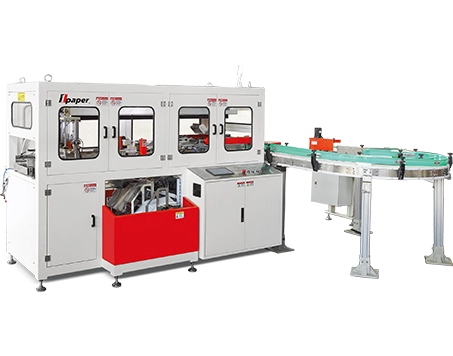
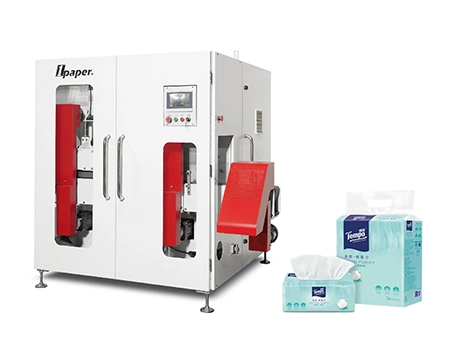
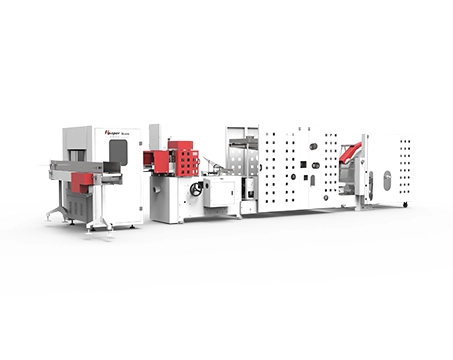
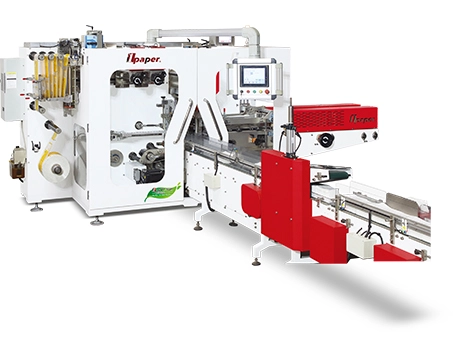
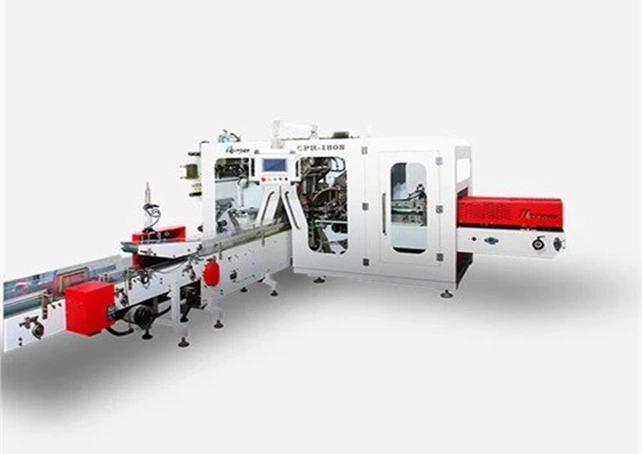
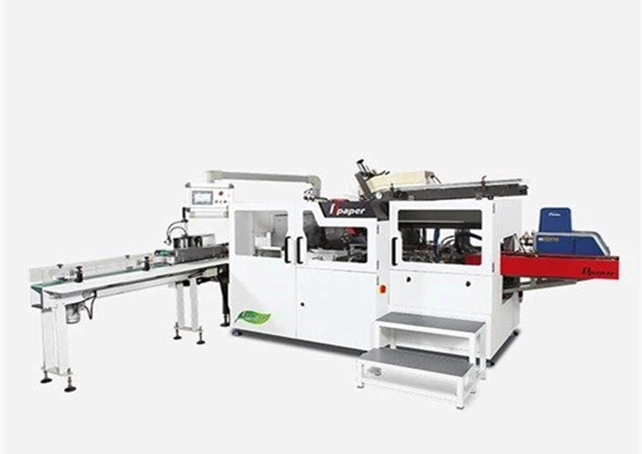
In facial tissue production, a tissue paper manufacturing machine refers to the converting line that transforms parent tissue rolls into finished facial tissue products. The line typically includes: jumbo roll unwind, embossing and ply bonding, folding, cutting, counting, stacking, and packing sections. The papermaking process that produces the parent rolls is a separate upstream operation. Converting line performance—particularly embossing pressure control, tension stability, and folding accuracy—determines the softness, appearance, and consistency of the finished product.
Q2: What is the difference between an automatic facial tissue machine and a semi-automatic line?
An automatic facial tissue machine integrates counting, stacking, transfer, and packing with recipe-driven control—producing higher consistency, lower labor per unit of output, and faster stable production across SKUs. A semi-automatic line requires more manual handling at the stacking and packing stages, which reduces capital cost but increases labor intensity, introduces more operator-to-operator variability, and typically limits the speed at which premium-grade consistency can be maintained. For plants targeting premium retail or export markets with tight specification tolerances, the consistency advantage of full automation usually justifies the higher initial investment.
Q3: What ROI and payback can I expect from upgrading to an automatic facial tissue machine?
Payback typically comes from four sources: higher throughput at stable quality, lower scrap and rework from web breaks and misfolds, reduced labor cost per case, and improved premium-grade acceptance rate (fewer customer claims and returns). The relative weight of each depends on your current operation. To build a realistic ROI model, share your current output per shift, labor cost per line, scrap rate, and the price differential between your premium and standard SKUs. Plants with high current scrap rates or significant labor costs at stacking and packing typically see the fastest payback.
Q4: Do we need to retrofit our workshop to install a new tissue paper manufacturing machine?
In most cases, yes—to some degree. The most common retrofit requirements are: compressed air capacity upgrade (fully automatic lines have higher air demand than semi-automatic), electrical distribution upgrade for servo drive systems, floor layout adjustment for material flow from parent roll storage through converting to packing, and downstream case handling alignment. The scope varies significantly by plant. A site layout and utilities checklist review before equipment order placement can confirm the minimum retrofit scope and prevent surprises during installation.
Q5: What parameters should we provide to select the right machine configuration?
To select and configure the right tissue paper manufacturing machine, provide: parent roll specifications (width, maximum diameter, core size), tissue basis weight (gsm) and ply count, desired fold type (V-fold or interfold) and finished sheet size, embossing pattern goals (pattern style, depth, changeover frequency), target converting speed and output (packs per minute or cases per day), packing format (bag or box), available floor space and utilities (power, air), and your current production problems (web breaks, emboss inconsistency, dust, misfolds, slow changeovers). The more specific the input, the more accurate the configuration recommendation and quotation.